


Host Systems
SPx Server is application software, designed to run on standard Intel PC or SBC hardware with Windows or Linux (see Spec tab), or on ARM hardware under Linux. The software is simple to install.
Target Extraction
The SPx Extraction process examines the processed video to search for target-like returns that form a connected target-like shape. A set of configurable parameters define the target size of interest, allowing small noise returns or larger clutter or land masses to be eliminated early in the processing.
The extraction process begins by creating a set of spans that represent intervals of video above a threshold for each processed return. These spans are then combined across returns to form connected two-dimensional shapes. The weighted centre of gravity, bounding box and total weight of the plot shape are calculated and entered into a plot database, along with a timestamp. At this stage of the processing, no merging occurs of close plots that are likely to be derived from the same target. This allows partial plots to be reported on the network, if desired, and allows the tracking process to consider the merits of merging in the context of the local tracks.
Secondary Surveillance Radar Extraction
Interrogation mode tags may be embedded at the start of the IFF video stream as P1/P3 pulses or a specific mode specified, telling SPx Server which responses to expect. The processing includes de-FRUITING and de-garbling to remove typical noise from an IFF video.
The IFF video handling capabilities provide a viable, highly cost-effective alternative to traditional hardware-based IFF decoding systems.
Track Creation
The tracker maintains an active track database, updated with new plot data from the data extraction stage. New tracks are added automatically or from a manual request (operator input or external process).
The automatic track creation occurs when plots entered into the database are uncorrelated, or ungated, with any existing known target. A new preliminary track is created and is updated with future detections until confidence is established that the track is likely to be a target of interest.
The time a track is held in the preliminary stage is a programmable option and needs to be set to balance the speed of detection with the likelihood of a false alarm. In a low clutter environment, where extracted plots are likely derived from real targets, the acquisition time may be as short as 2 detections. For noisy situations, where the plot extractor is reporting false detections, the integration time in the preliminary stage may be extended.
Model Based Tracking (MBT)
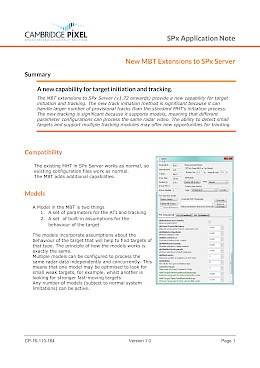
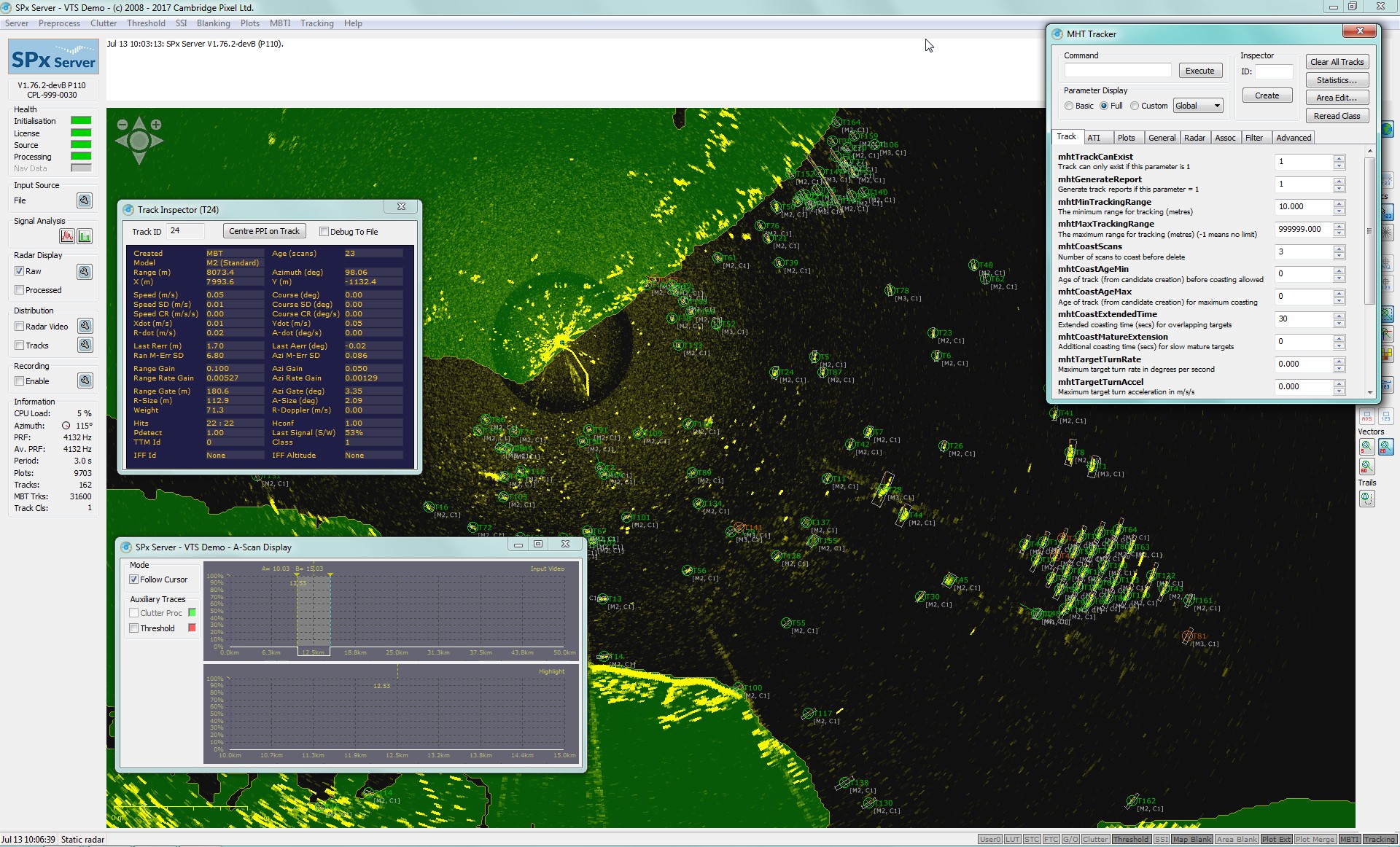
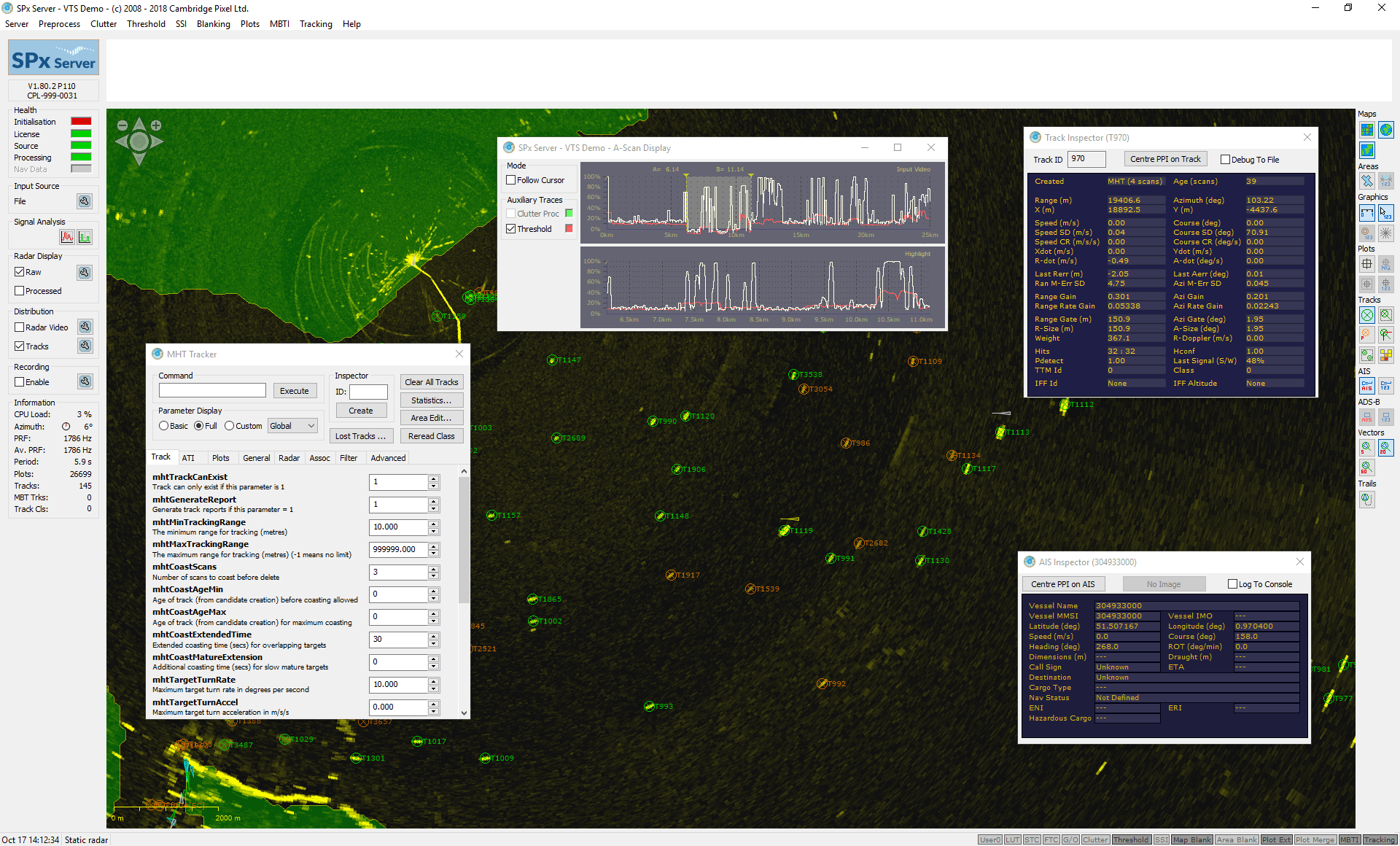
The MBT extensions to SPx Server (V1.72 onwards) can handle a larger number of provisional tracks than the standard MHT's initiation process. This allows specific target models to be created, meaning that different parameter configurations can process the same radar video. This allows small, low-observable targets such as drones to be detected and tracked alongside conventional targets in the same radar video. MBT extensions application note.
Track Filter
For each hypothesis, the tracker updates the current estimated position with the new measurement. If the measurement were known to be completely accurate, the update process would believe the measurement and the new estimate would be exactly the measured value. For various reasons, the measurement is inaccurate so the update process must take a weighted combination of the expected position and the measured position. This is the track filtering. SPx offers a number of track filtering modes. The simplest mode uses fixed gains in the components of the measurement. This can be successful for tracking applications where the target is clearly identified and relatively clutter free.
The filter works by computing a dynamic filter gain, K, based on estimated system noise and measurement noise models. The system noise is used to model uncertainty in the known dynamics of the target, including its ability to manoeuvre. As system noise increases, or equivalently as measurement noise decreases, the filter places more weight on the measurement so the filter gains increase. As system noise decreases or as measurement noise increases, the filter gains decrease, causing less emphasis to be placed on the new measurement. The filter gains are continually changing and provide, under certain assumptions of the noise characteristics and linearity, an optimal estimation of the true target position.
Three Versions Available
As standard, there are three main versions of SPx Server, each of which progressively adds additional processing functionality:
- SPx Distribution Server – includes primary radar digitisation and network streaming
- SPx Detection Server – adds both plot extraction and proximity detection processing
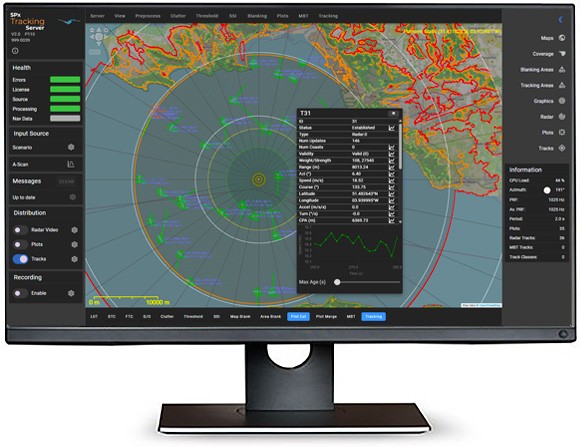
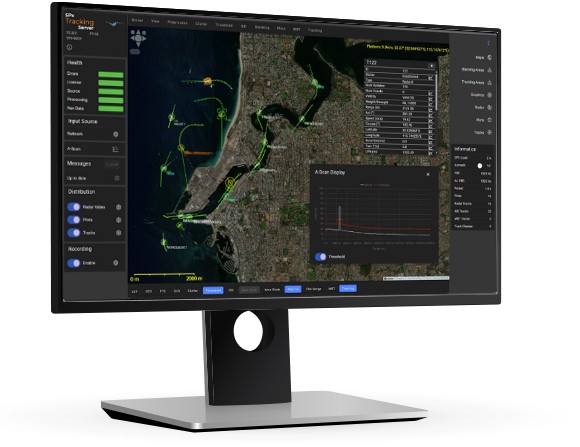
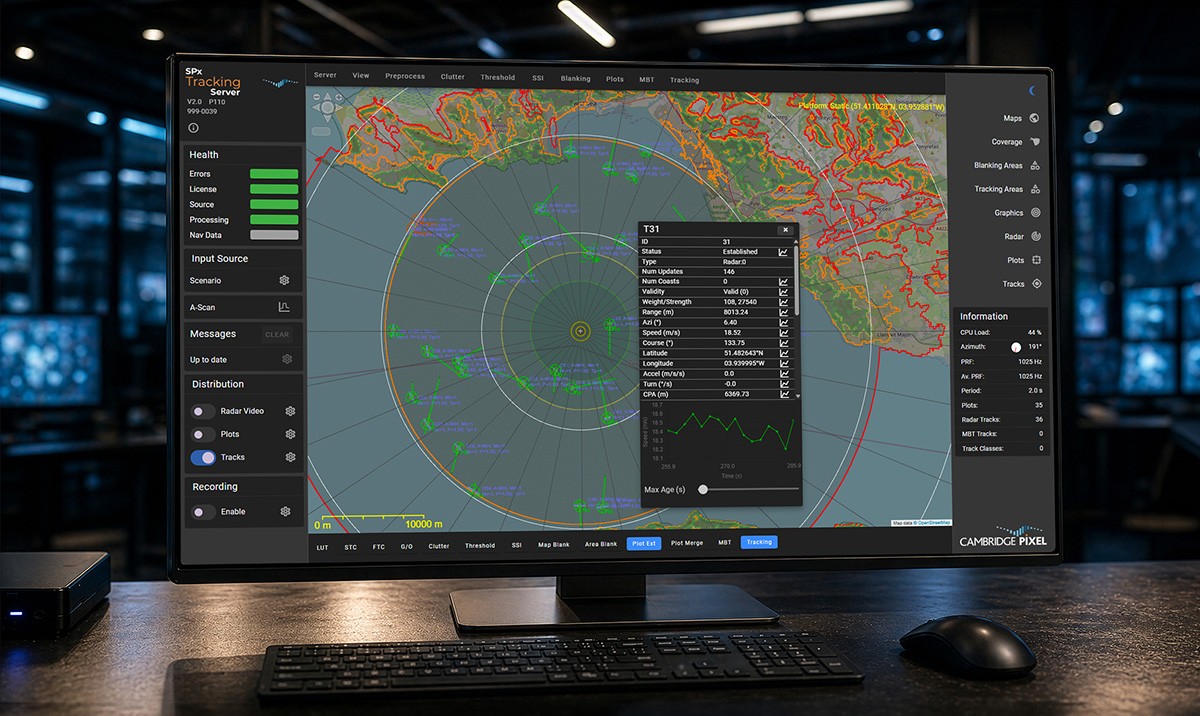
- SPx Tracking Server – offers a complete multi-hypothesis primary radar tracking solution
There are also embedded variants of each optimised for the HPx-700 Radar Input and Processing Unit.
New Features Added
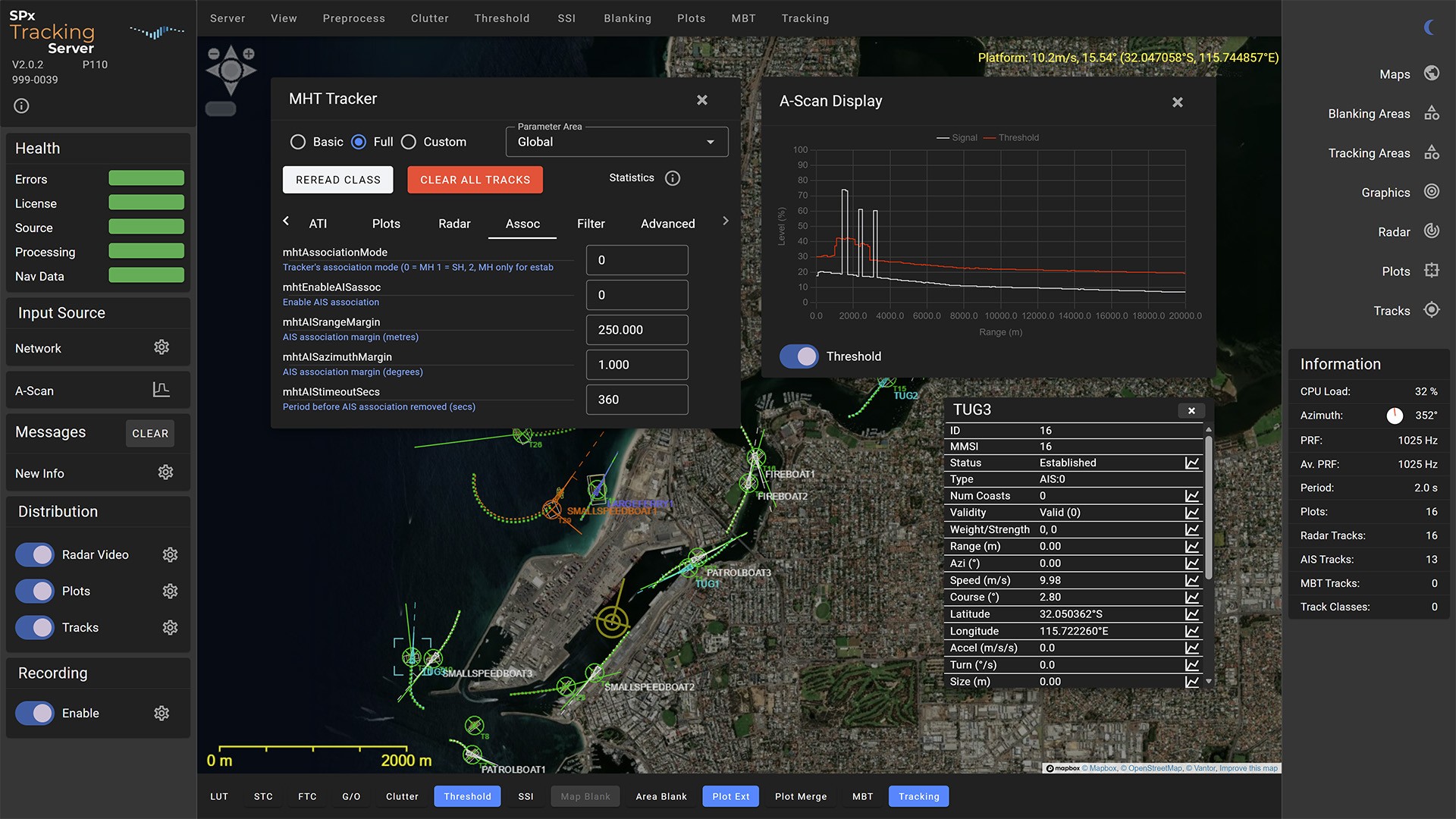
The latest version, SPx Server V2.0, adds new capabilities including:
- Proximity Detection - for collision avoidance and autonomous navigation
- HPx-700 Support - includes controls for the HPx-700 Radar Input & Processing Unit
- TAK & SAPIENT Support - output track formats for interoperability with modern C2 systems
- AI-assisted System Configuration - uses Machine Learning to streamline setup and optimise processing parameters
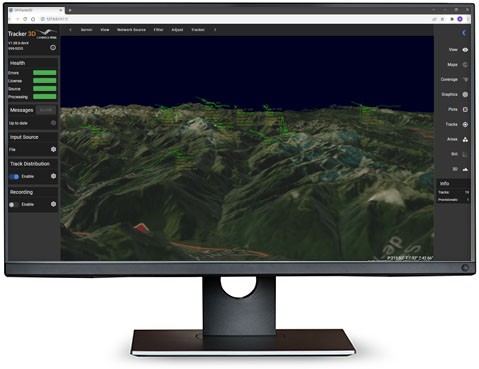
- Radar Coverage Display - uses terrain data and radar parameters to provide an integrated display of coverage and blind spots
- Enhanced track reporting and plot history visualisation
- Configurable track labelling for clearer operator displays
- Multi-function primary and secondary (IFF) radar processor
- Radar video from HPx cards or network
- Radar processing
- Filtering
- CFAR Thresholding
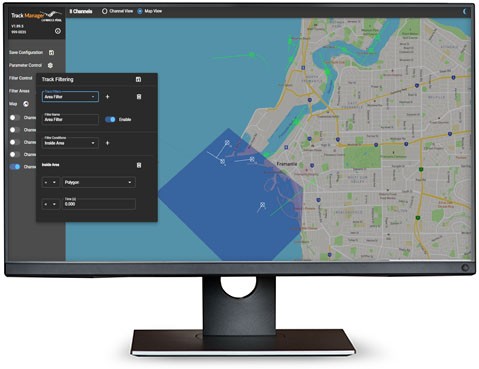
- Area-based video filtering/masking
- Clutter map generation
- Plot Extraction and merging
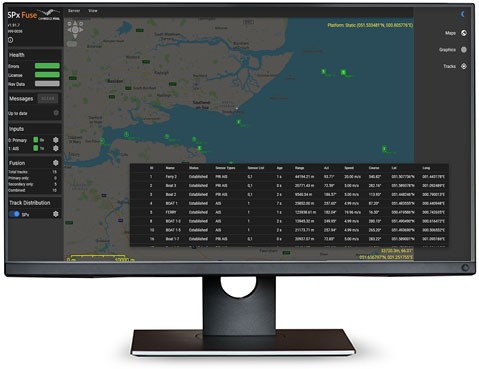
- In-built AIS association
- AIS track display and recording
- Doppler Video support
- Multi-hypothesis target tracking
- Model-based tracking extension
- Fully configurable tracking
- Area-dependent tracking parameters
- Full auto track initiation
- Redundant operation, with automatic failover
- Built-in world coastline database
- Static or moving platform
- Automated pitch and roll correction
- NMEA navigation input for ship systems
- Radar network distribution
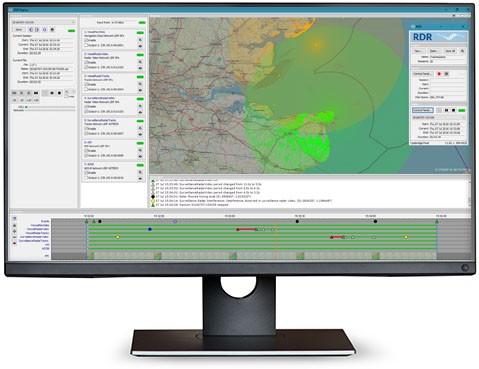
- Radar, NMEA and AIS record/replay
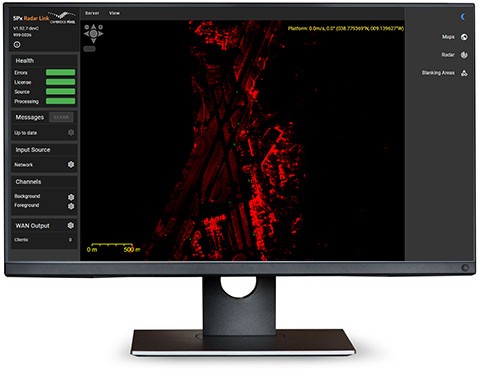
- Comprehensive configuration GUI
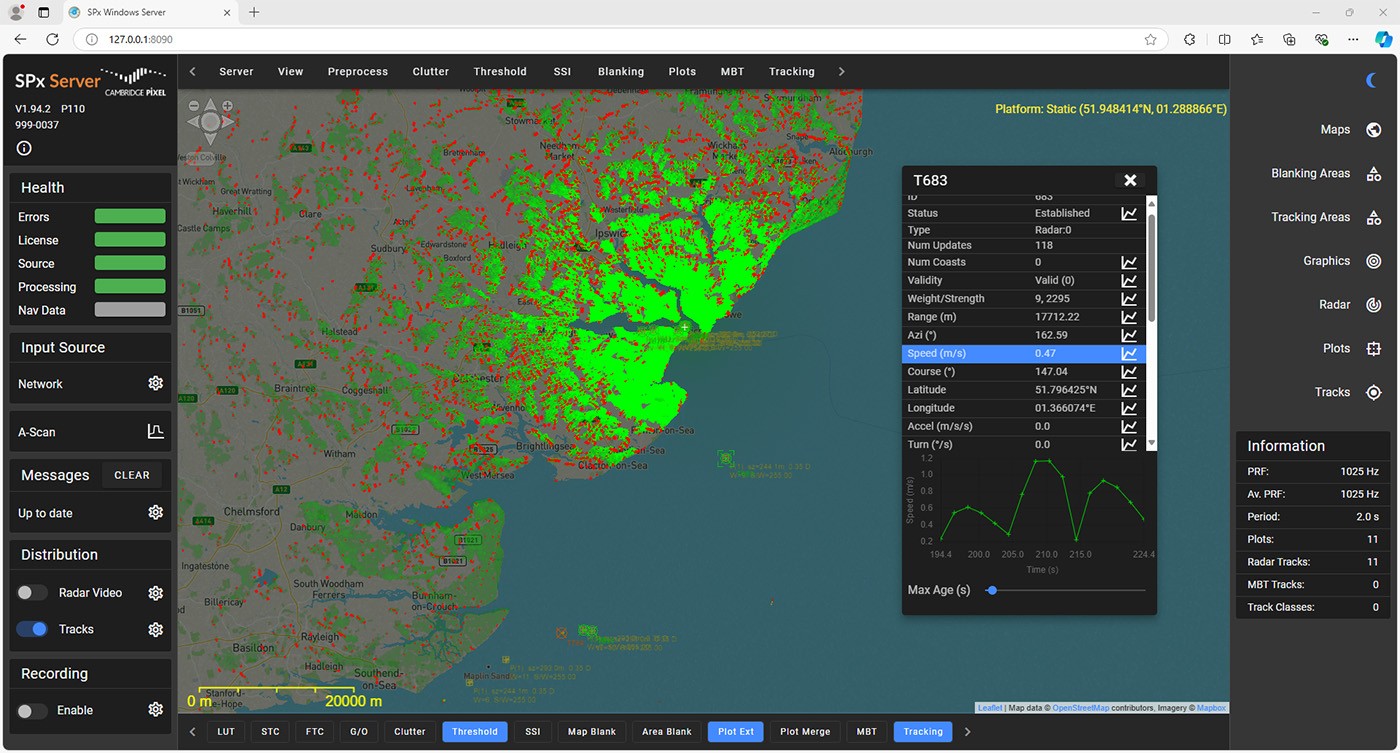
- Web Interface for control and graphical monitoring
- Sidelobe suppression
- ARM support
- Windows or Linux versions
- Network remote control and API
- Receipt and tracking from plot data
- Receipt and distribution of lidar data
- Video, plot and track output to network
- Fully configurable for:
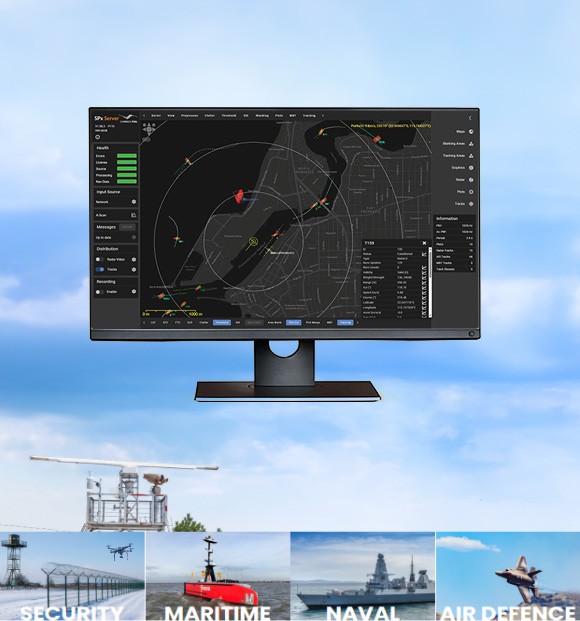
- Air defence, military ATC and airport surface movement
- Border and critical infrastructure security
- Counter-UAS and small targets
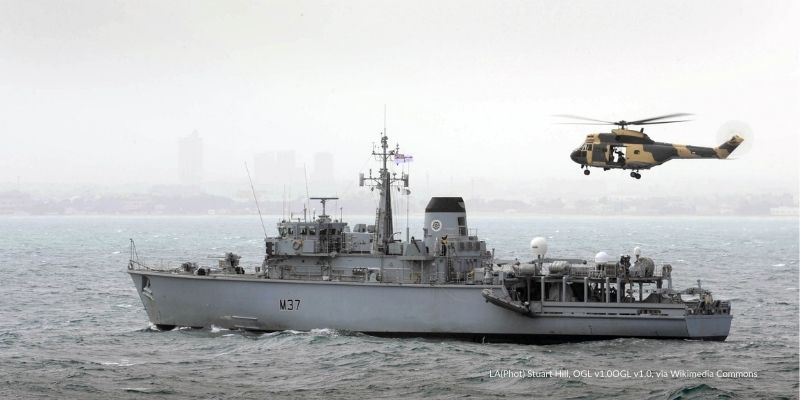
- Maritime surveillance, coastal, VTS/VTMS
- Maritime platforms, ARPA, ECDIS, Integrated Bridge displays
- Military firing range security
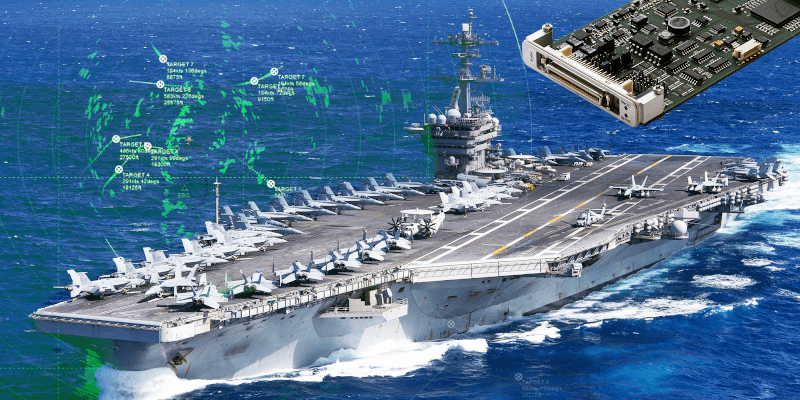
- Naval defence, combat management systems
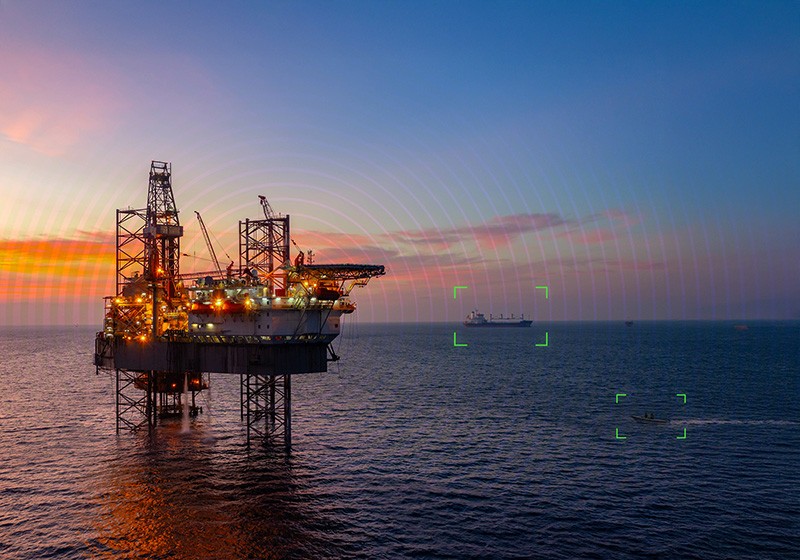
- Offshore platform security, wind farms, oil and gas
- Surface movement radars
- USVs and ASVs

System Requirements
- Processor
- Intel Core i5 (10th gen. or newer) with 16 GB RAM, ARM Cortex-A72 (or better) or HPx-700 radar input & processing unit
- Operating System
- Windows 11 and Linux (Fedora, Ubuntu & RHEL)
- For other operating systems, please consult Cambridge Pixel
- Graphics
- Native Windows GUI requires a graphics display resolution of at least 1024x768 for configuration
- Note: use of native GUI is not essential and web interface is available
- Network Interface
- 1 Gbit Ethernet adaptor recommended
- Analogue Input Option
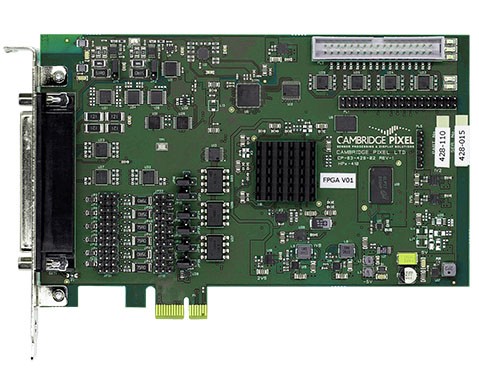
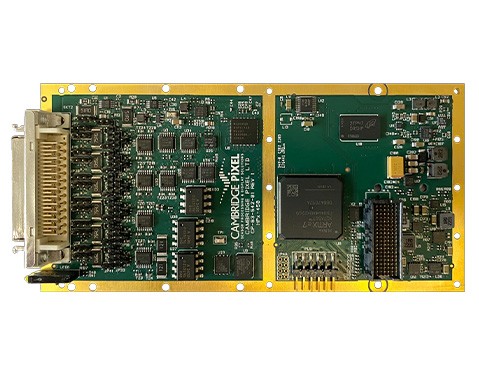
- HPx-410 PCIe or HPx-450 XMC cards (for Intel/PC systems)
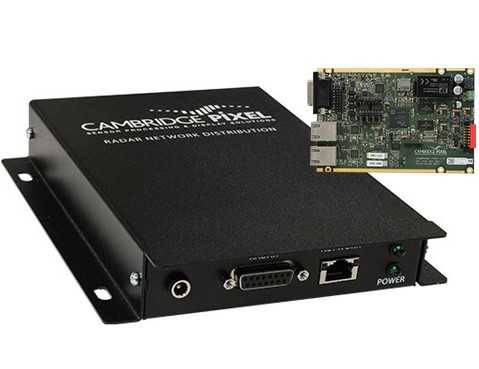
- HPx-700 has built-in signal acquisition hardware
Software Licensing
- Licensed Functions
- Radar video distribution
- Plot extraction
- Target extraction
- Licence Protection Method
- USB Dongle
- MAC-address licence file
- (other schemes are possible, consult factory for details)
Radar Interface
- Analogue Radar Input
- Hardware interface card: HPx-410, HPx-450
- Hardware interface unit: HPx-346, HPx-700
- Network Radar Video Input
- Supported formats, including: ASTERIX CAT-240, Terma, Simrad, Navtech, Furuno, Raymarine, Garmin and others.
- Plot Inputs
- Option to receive plot data from proprietary radars. Consult factory for details.
Navigation Information
- Platform Navigation
- NMEA-0183 input including: RMC, GGA, HDT, HDG, XDR, PASHR sentences
- Physical Interface
- Serial port or Ethernet
- North Offset Adjustment
- Incoming azimuths may be ship or North referenced, with automatic conversion to North referenced from navigation data, as required.
Processing
- Threshold Detection
- Adaptive threshold CFAR, using moving-window average
- Clutter Processing
- Clutter mapping using scan-to-scan correlation
- Clutter subtraction, pseudo-MTI video
- Video Masking
- World vector shoreline: land masking using built-in database of world shoreline data (static installations only).
- User-defined polygon: complex fixed world or platform-relative polygons, including holes (static or moving platforms).
- Area-Dependent Processing
- Tracker parameters can be assigned different values in different user-defined areas.
- Suppression of automatic track initiation (no-ATI zones)
- Optional automatic suppression of plots over land areas using world vector shoreline database (static or moving platform).
- Plot Extraction
- Configurable plot geometry (min/max range and azimuth)
- Optional plot merging (multiple modes)
Digital Video Distribution
- Network Distribution
- Distribution onto LAN of radar video data in polar format
- Compression
- Zlib or ORC (Open Radar Coding)
- Data Rates
- Highly dependent on input data and configured resolution.
- Typical figures from 2 Mbits/sec for processed video to 10 Mbits/sec.
- Network Protocol
- UDP - Unicast or Multicast distribution
- Distribution Channels
- 3 independent channels.
- Each channel may be raw (unprocessed), processed or clutter map video data
Target Tracking
- Maximum Number of Targets
- Set to 4000 as standard. Increased configurations can be requested.
- Track Initiation
- Automatic, with programmable extraction areas
- Automatic wake area elimination (configurable geometry)
- Shadow area (multipath) elimination from known targets
- Manual track initiation from remote system
- Configurable min/max initiation speeds, which may be area dependent
- Max initiation speed: 1000 m/s
- Minimum initiation range at maximum speed:
- 10 NM for targets moving tangential to radar
- 3 NM for targets moving radially towards or away from radar
- Programmable initiation time from 2 scans upwards using M:N or SPRT integrator. Initiation criteria may be area dependent.
- Target Speeds
- Programmable minimum and maximum target speed for initiation in the range 0 to 1000 m/s
- Programmable minimum and maximum target speed for tracking in the range 0 to 1000 m/s
- Tracking Performance
- Figures are highly dependent on sensor, operating conditions and configuration data.
- Sample configuration - sea state 1, 100m2 RCS target:
- For radar range 200NM, target at 100 NM
- Position accuracy: σ = 90m
- Range accuracy: σ = 90m
- Azimuth accuracy: σ = 10 secs arc
- Speed accuracy: σ = 5% of true speed for speeds above 5 m/s, σ = 10% of true speed for speeds below 5 m/s
- Course accuracy: σ = 1 degree
- For radar range 70NM, target at 35NM
- Position accuracy: σ = 25m
- Range accuracy: σ = 25m
- Azimuth accuracy: σ = 10 secs arc
- Speed accuracy: as above
- Course accuracy: as above
- For radar range 35NM, target at 18NM
- Position accuracy: σ = 20m
- Range accuracy: σ = 20m
- Azimuth accuracy: σ = 10 secs arc
- Speed accuracy: as above
- Course accuracy: as above
- Notes: Performance figures are typical, but depend on exact characteristics of radar and target. Target assumed to be moving in straight line. If server is applying North offset compensation, timely updates of ship's heading are critical for good tracking performance. Quoted values of σ are standard deviations of errors.

 Meet us at: